Quick Answer
Pick your underscrub in five decisions: shift type → fabric → sleeve length → fit → color/pattern. Cold OR = ThermoLite. Mixed floor = AeroKnit or FlexForm. Warm clinic = CloudSoft Short Sleeve. Between two sizes? Size up. Build to 5–8 pieces, mixing neutrals with patterns.
Most underscrub-buying advice online is either "buy this one specific product" or "look for these vague qualities." This guide does neither. It walks you through five decisions in the order you should make them — shift type, sleeve length, fabric, fit, and color — so you end up with the right underscrub for your specific work, not just one that someone wrote a sponsored review for.
Decision 1: Match the underscrub to your primary shift type
The first and most important question is what shift you're going to wear this underscrub on most. Five common patterns:
Pattern A: Cold OR, cath lab, or recovery (consistent cold)
You stand for long periods in 60–68°F air. Your priority is warmth without bulk. Look for: - Long sleeve, mockneck or higher scoop - Brushed-inner fabric, 180–220 GSM - ThermoLite, merino, or similar thermal fiber blend - Slim fit so it fits under fitted scrub tops without bulk
Our pick: ThermoLite Mockneck Underscrub
Pattern B: Mixed-temperature floor (ER, telemetry, med-surg)
Your shift swings from warm patient rooms to cold supply closets to warm break rooms. You need versatility. Look for: - Long sleeve - Standard 150–180 GSM nylon-spandex - Scoop or low V neckline - Wicking fabric to handle the warm rooms
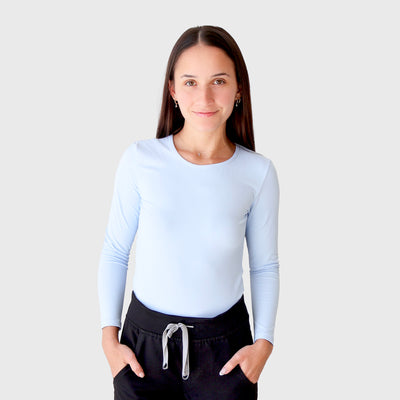
Our pick: AeroKnit Seamless Long-Sleeve Underscrub, or the CloudSoft Long Sleeve ($38) if you want a lighter, softer layer
Pattern C: Warm clinic, outpatient, or summer shifts
You're in a warm clinic, dental practice, or outpatient setting. Your priority is breathability and opacity, not warmth. Look for: - Short sleeve or sleeveless tank - Lighter fabric (140–160 GSM) - Wicking blend - Especially important: opacity test, since light fabrics are usually less opaque
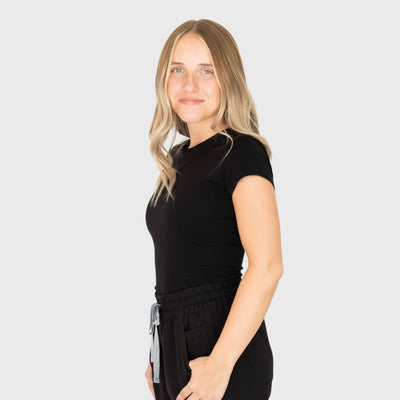
Our pick: CloudSoft Short Sleeve Underscrub
Pattern D: Long active shifts (peds emergency, code response, ER triage)
You move constantly, you sweat hard, you need full freedom of motion. Look for: - Fitted but not compressive - Wicking, lightweight (140–170 GSM) - Short sleeve, or a lightweight long sleeve - Flat-locked seams to reduce chafing
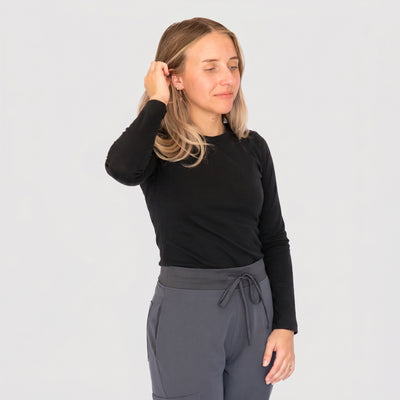
Our pick: AeroKnit Seamless Long-Sleeve Underscrub (the seamless construction is built for this exact use case)
Pattern E: Long static shifts (cath lab procedural, sonography, dental hygienist)
You stand or sit for long periods with sustained focused movement. Your priority is comfort and steady support. Look for: - Light compression / "compressive feel" without medical-grade pressure - Long sleeve for any cold environment - Soft against skin for static contact
Our pick: FlexForm Compression Long-Sleeve Underscrub
Decision 2: Sleeve length
If you only have to pick one underscrub and you don't know what your shifts will mostly look like, here's the rule:
- Three months in cold OR or northern hospital in winter → long sleeve, mockneck preferred
- Mixed floor work in moderate climates → a lightweight long sleeve is the most versatile single piece (warm enough for cold rooms, breathable enough for the floor)
- Warm climate, outpatient, or summer-only → short sleeve
If you can buy more than one, the most common combination among nurses we talk to is one long sleeve + one short sleeve, so you can swap based on shift.
Decision 3: Fabric (the part most people skip)
Fabric is where cheap underscrubs fail. Don't skip this section.
What to look for on a fabric spec
- Primary fiber: nylon or polyester are both fine (nylon usually lower odor)
- Spandex content: 10–20% for natural underscrub feel; 20–30% for slight compressive feel
- GSM (fabric weight): 140–170 for warm shifts, 150–200 for moderate, 200+ for cold OR
- Tested for opacity: if the brand publishes this, good sign; if they don't, ask
- Odor-control treatment (silver, copper, zinc): nice-to-have, not required
Fabrics to avoid
- 100% cotton (bunches and stays wet)
- 100% polyester (cheaper underscrubs; smells fast)
- Pure spandex (too compressive for all-day non-athletic wear)
- "Bamboo" fabrics — usually overhyped for healthcare. Marketing claims (eco-friendly, naturally antimicrobial, ultra-soft) often outpace real-world durability under hospital laundry conditions. The soft feel is real; the long-term performance often isn't.
Where to find the fabric spec
A good brand publishes their fabric composition and GSM on the PDP. If it's not there, that's a yellow flag — the brand probably doesn't know its own fabric well or doesn't think you'll care. The ALA fabrics page has full spec for each of our pieces.
Decision 4: Fit
The whole point of an underscrub is that it disappears under the scrub top, so this is not a garment to buy two sizes big — a genuinely loose underscrub bunches at the waist, balls up at the underarm, and twists across the shoulder by hour six. Between two adjacent sizes, though, the larger is the safer pick: it still sits smooth, while the smaller pulls at the bust and rides up at the hem over a full shift.
The right fit is:
- Snug across the chest without compression
- Hem at hip bone or lower so it stays tucked
- Sleeve cuff at wrist with no looseness
- Smooth across the back (no fabric pooling at the shoulder blade)
If you're between sizes, size up, not down. The fabric relaxes a little in the first few wears, and the larger size is the one that stays smooth through hour twelve.
For size guidance, the ALA size guide has detailed body measurements and fit notes per silhouette.
Decision 5: Color and pattern
Treat color and pattern like an accessory decision, not a base-layer decision. The right underscrub complements the rest of your outfit instead of trying to vanish under it. Like a bag, a watch, or jewelry, it's a deliberate layer that adds to the look.
Some guidance to start:
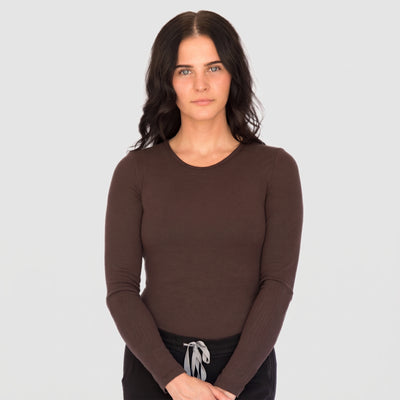
- Darker scrubs (navy, black, charcoal, hunter green) — a contrasting underscrub at the neckline reads as a deliberate layer. Walnut brown, espresso, cream, and soft taupe all show through nicely.
- Lighter scrubs (light blue, pastel pink, sky, white) — lean into pattern. A small polka dot, subtle stripe, or feminine print at the neckline shows through and adds personality without screaming.
- Patterns are increasingly what nurses want. The category has been stuck in solids forever; the appetite for pattern is real and it's the direction the category is moving.
- Skin-tone neutrals (warm taupe, mocha, soft beige) — work as the "default" underscrub when you want a near-invisible look at the neckline.
- Black — works under dark scrubs; visible under light scrubs; reads as deliberate either way.
- Bright white — usually less opaque than darker shades, and rarely complements rather than competes. Skip it as an everyday underscrub.
The strongest underscrub wardrobes mix neutrals (for blend-in days) with patterns (for personality days). Most nurses building toward a real wardrobe end up with roughly half neutrals and half pattern/color.
How many underscrubs to own
Most nurses underbuy underscrubs and then realize at six months they want more. A realistic build:
- Just testing the category: 1 to confirm fit and feel
- First serious wardrobe: 3–5 in rotation, covering long sleeve and short sleeve, plus a pattern or two
- Full working wardrobe: 5–8 across all sleeve lengths, with a real mix of neutrals and patterns
- Wardrobe complete: 8–12, organized by shift type, with patterns and colors for the days when the rest of the outfit is plain
Once you have a working wardrobe, the daily-getting-dressed decision becomes a small piece of fun — which color, which pattern, which weight today — rather than a uniform pull. That's the point.
If you're between two sizes or unsure about fit, our fit guide walks through the specific cases — bust, height, and compression pieces — which is a faster route than ordering twice and returning one.
Price expectations
Underscrubs span a range:
- $15–25: uniform store basics, usually polyester, expect 6–12 months of life
- $30–50: better fabric, better construction, expect 12–18 months
- $50–80: premium fabric and construction (ALA runs $38–$68)
- $80+: specialty (merino wool blends, advanced antimicrobial treatments)
The breakdown over time: a $25 underscrub that lasts 12 months costs about $2/month. A $60 premium underscrub that lasts 24+ months costs about $2.50/month — and feels better every shift in between. The math usually works for premium.
A quick decision matrix
| You're a... | Get this | Plus this |
|---|---|---|
| New nurse, first underscrub | AeroKnit Seamless Long-Sleeve | A second in a different color |
| OR nurse | ThermoLite Mockneck | FlexForm Compression for cold cases |
| ER / floor nurse | AeroKnit Seamless Long-Sleeve | CloudSoft Short Sleeve for warm rooms |
| Warm-climate / outpatient | CloudSoft Short Sleeve | Another in a different color |
| Long static shifts (cath lab, sonography) | FlexForm Compression Long-Sleeve | A second for laundry rotation |
| Want to compare with FIGS first | Read ALA vs FIGS | Then pick from the table |
Frequently asked
Should underscrubs be tight or loose?
Fitted, not loose. An underscrub should sit snug across the chest without compressing, stay smooth across the back, keep its cuff at the wrist and reach the hip bone so it stays tucked. A loose one bunches and twists by mid-shift.
Should I size up or down between sizes?
Size up. Between two adjacent sizes, the larger one still sits smooth, while the smaller one pulls at the bust and rides up at the hem over a 12-hour shift. Just don't go two sizes big, because a genuinely loose underscrub bunches.
How many underscrubs do I need?
Start with one to confirm fit and feel, then build to three to five in rotation, covering long and short sleeves. Most nurses settle at five to eight pieces, mixing neutrals for blend-in days with a pattern or two for personality.
Short or long sleeve for a mixed floor?
If your unit allows sleeves, a lightweight long sleeve is the most versatile single piece for a mixed floor: warm enough for cold rooms, breathable enough for patient rooms. With two, pair one long sleeve and one short sleeve and swap by shift.
Want to keep reading?
- Care & longevity guide — how to keep your underscrubs in great shape for years
- Our fabrics — the science behind each ALA blend
- Size & fit guide — find the underscrub that disappears under your scrub top
- ALA vs FIGS comparison — how we compare to the category leader
- Underscrubs 101: The Complete Guide — the broadest overview of the underscrub category